
Our Beanbag Saves 46.5 PET Bottles from the Ocean
The modern world is filled with plastic. From milk tea cups to soap bottles, PET plastic is everywhere. Globally, 20,000 PET bottles are produced every single second①. While it takes only moments to mould a bottle, it takes 450 years for that same bottle to degrade.
Despite their long life span, you rarely see an old plastic bottle. Of the one million bottles sold every minute②, half are single-use. They are used briefly and thrown away immediately. Most PET bottles never get the chance to grow old. 72% of plastic packaging is never recovered③. It is tossed on the street, buried in landfills, or leaked into our oceans. Another 14% is burned, releasing harmful substances.
We are interested in the final 14%. This is where plastic finds a second life.

From a Bottle to a Beanbag
Some bottles become clothes, bags, or shoes. Others are turned back into bottles. But we wondered: could they have a completely different life?
The journey of repurposing PET bottles is a rigorous one. It goes through screening and sorting, deep cleaning, crushing, and separation at high temperatures. These bottles are transformed into polyester granules, then into eco-friendly fibres, and finally into a high-quality recycled fabric.
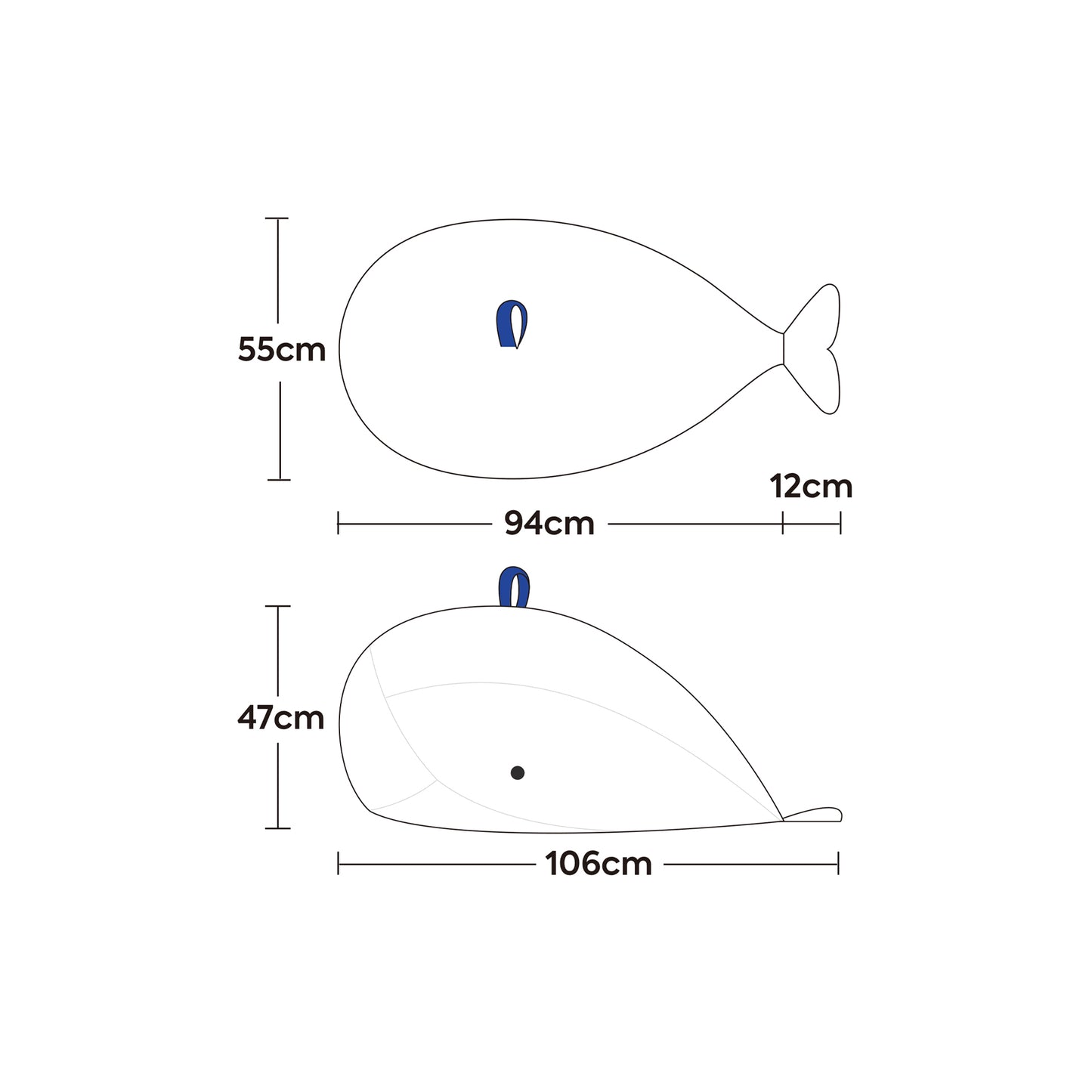
We used this recycled material to create our Eco Whale Beanbag.
- The math: One Eco Whale Beanbag equals 46.5 recycled plastic bottles④.
- The impact: These bottles will never flow into the ocean. This recycling effort is equivalent to turning off 600 LED lights for one hour.

The Ocean's Giant Carbon Banks
Whales are the most important carbon sinks in our ocean. They store massive amounts of carbon in their bodies, and when they die naturally, that carbon is buried in the deep sea.
However, when whales die from eating plastic or getting stranded, that cycle breaks. This causes tons of carbon dioxide to be released into the atmosphere every year. The UN has called for the world to recognise how the ocean regulates our climate.
By introducing the Eco Whale Beanbag, we are inviting you to adopt a whale and care for the Earth a little more.

Data Sources & Partners
① United Nations Development Programme (UNDP)
② United Nations Environment Programme (UNEP)
③ Ellen MacArthur Foundation, 'The New Plastics Economy', 2016
④ Recycling and carbon reduction data provided by BOTTLOOP, a GRS (Global Recycled Standard) certified brand.
Special thanks to our sustainability partner, BOTTLOOP, for their research and development support on the materials of the Eco Whale Beanbag.